

Why invest in asset protection: cut risks by 40% in 2026
A new lawsuit is filed every 30 seconds in the U.S., posing constant risks to personal and business assets. Lawsuits and creditor claims threaten your wealth daily. This guide offers clear strategies combining legal structures, insurance coverage, and physical security protections. You’ll learn how to safeguard wealth effectively as a U.S. homeowner or small business owner through practical, layered defenses.
Table of Contents
- Understanding The Foundation Of Legal Asset Protection
- Legal Strategies: Llcs, Trusts, And Business Structures
- The Necessity Of Layered Asset Protection: Legal, Insurance, And Physical Security
- Common Misconceptions And Pitfalls In Asset Protection
- Practical Steps For Homeowners And Small Business Owners To Implement Asset Protection
- Summary: Strategic Asset Protection For Long-Term Security
- Protect Your Assets With Advanced Security Solutions
- Why Invest In Asset Protection: Common Questions
Key takeaways
| Point | Details |
|---|---|
| Legal asset protection is most effective when planned proactively | Structures like LLCs and trusts must be established before threats arise to withstand court scrutiny. |
| LLCs and trusts separate and shield assets but require maintenance | Proper documentation, separate accounts, and ongoing compliance prevent piercing of protection. |
| Combining legal tools with insurance and physical security creates robust protection | No single method suffices; layered defenses maximize risk reduction across all threat types. |
| Common pitfalls include asset commingling and delayed implementation | Over 60% of protections fail due to improper maintenance and reactive planning. |
| Practical steps include risk assessment, legal structuring, insurance updates, and security investments | A sequential approach ensures comprehensive coverage tailored to individual exposure. |
Understanding the foundation of legal asset protection
Legal asset protection must comply with laws and be implemented before creditor exposure. You cannot legally hide assets or transfer them fraudulently after a lawsuit begins. Courts increasingly pierce poorly planned asset protection schemes, making timing and legality critical.
The Corporate Transparency Act 2025 increased scrutiny on asset transfers and beneficial ownership reporting. You must now disclose more information about entities holding your assets. This transparency makes illegitimate schemes easier to detect and invalidate.
Asset protection trusts established before creditor threats offer stronger legal standing, with protection periods as short as two years in some states. Domestic asset protection trusts provide creditor barriers when properly timed. Understanding statutes of limitations and fraudulent transfer laws is crucial for success.
Key principles for legal asset protection tactics:
- Establish structures well before any creditor claims or lawsuits arise
- Maintain full compliance with state and federal reporting requirements
- Document legitimate business purposes for all asset transfers
- Avoid transfers that appear fraudulent or intended solely to delay creditors
- Work with experienced attorneys to ensure legal validity
Legal strategies: LLCs, trusts, and business structures
Forming an LLC separates personal and business liabilities but requires maintenance to avoid veil piercing. You must keep business and personal finances completely separate. Use dedicated business bank accounts and never pay personal expenses from business funds.
Asset protection trusts differ by their creditor protection periods and legal oversight. Some states offer two-year lookback periods while others require longer waiting times. Separating business and personal assets significantly reduces creditor claims when structures are maintained properly.
Maintaining separate documentation is critical. Keep detailed records of all business transactions, minutes of meetings, and resolutions. File annual reports on time and pay all required fees. These steps prove you treat the entity as legitimate, not merely a shell.

Pro Tip: Review entity compliance quarterly and avoid signing personal guarantees on business debts whenever possible to maximize liability separation.
Comparison of LLC asset protection versus domestic asset protection trusts:
| Feature | LLC | Domestic Asset Protection Trust |
|---|---|---|
| Setup complexity | Moderate; state filing required | High; requires attorney and trustee |
| Creditor protection strength | Good with proper maintenance | Excellent when established early |
| Ongoing compliance | Annual reports and fees | Trust administration and reporting |
| Flexibility | High; owners control operations | Limited; trustee controls assets |
| Cost | $500 to $2,000 annually | $3,000 to $10,000+ setup plus annual fees |
For detailed guidance on business asset protection strategies, consider both entity type and your specific risk profile. The right structure depends on your asset values, industry risks, and operational needs. Consult with legal and financial advisors to design your optimal protection plan following the business asset protection guide.
The necessity of layered asset protection: legal, insurance, and physical security
Legal structures reduce liability exposure but cannot prevent all financial loss. Insurance covers many risks but doesn’t isolate assets legally. Physical security, including safes and cameras, protects tangible assets and deters threats. Effective asset protection employs a layered defense combining all three.
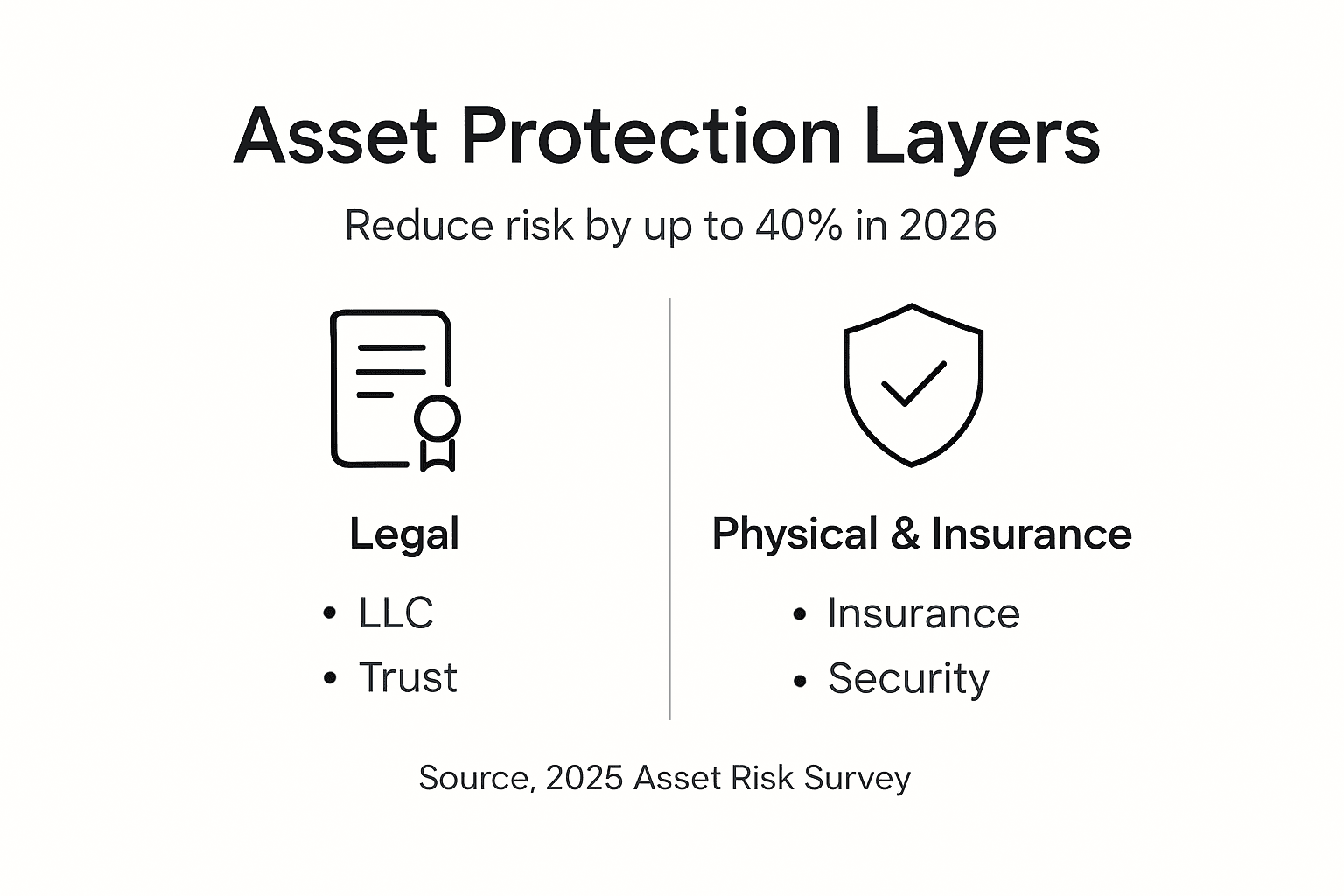
Every 30 seconds a new lawsuit is filed in the U.S., underscoring the importance of multi-layered protections. Liability insurance reduces out-of-pocket losses by roughly 70% for small businesses but does not replace legal asset separation. 43% of cyberattacks target small businesses, causing average costs of $200,000 per breach.
Key elements of comprehensive protection:
- Legal setup through LLCs, trusts, or other entities to create liability barriers
- Insurance coverage including general liability, professional liability, property, and cyber policies
- Physical safeguards like fireproof safes, surveillance systems, and access controls
- Cybersecurity measures protecting digital assets and sensitive data
- Regular reviews and updates as risks and regulations evolve
Risk reduction impact by protection layer:
| Protection Layer | Primary Risk Addressed | Estimated Risk Reduction |
|---|---|---|
| Legal structures (LLC/Trust) | Lawsuits and creditor claims | 30% to 50% |
| Liability insurance | Financial damages from incidents | 60% to 80% |
| Physical asset protection | Theft, fire, unauthorized access | 40% to 70% |
| Cybersecurity | Data breaches and digital theft | 50% to 75% |
Pro Tip: Conduct annual risk assessments to identify new vulnerabilities and adjust your layered protection accordingly; threats evolve faster than most protection plans.
For homeowners and small business owners, smart safes benefits include remote monitoring and instant alerts when breaches occur. Combining these with legal structures documented in lawsuit protection statistics creates formidable barriers. Understanding the insurance role in asset protection helps you calibrate coverage limits. Recognizing cybersecurity importance for asset protection prevents digital losses that devastate businesses.
Common misconceptions and pitfalls in asset protection
Myth: Forming an LLC alone guarantees absolute protection. False. Without proper maintenance, courts can pierce the corporate veil and hold you personally liable. Commingling personal and business assets leads to this piercing and loss of protection.
Insurance is vital but insufficient as sole protection. Policies have limits and exclusions. They pay damages but don’t legally separate assets. You need both insurance and legal structures.
Over 60% of LLC protections fail due to improper maintenance and commingling of assets. This statistic reveals how easily protections collapse when owners neglect basic compliance.
“The majority of asset protection failures stem not from sophisticated attacks but from owner negligence in maintaining entity formalities and separating finances.”
Proactive planning and documentation prevent most pitfalls. Keep meticulous records of all transactions. Never use business accounts for personal purchases. File required reports on time. Hold annual meetings and document decisions.
Common errors leading to asset protection pitfalls:
- Mixing personal and business funds in the same accounts
- Signing personal guarantees on business loans unnecessarily
- Forming entities after creditor threats or lawsuits begin
- Failing to update registered agent information or file annual reports
- Ignoring insurance policy renewals or coverage gaps
- Neglecting physical security despite holding valuable assets
Understanding common asset protection mistakes helps you avoid expensive court battles. Many protections fail simply because owners treated their LLCs as personal extensions rather than separate legal entities. Courts have little sympathy for formalities ignored.
Practical steps for homeowners and small business owners to implement asset protection
Evaluating risk exposure and updating insurance policies are essential first steps. You must know what you’re protecting and from what threats. Small business owners face different risks than homeowners, though both need layered defenses.
Implementation sequence:
- Assess personal and business risk exposures thoroughly by reviewing assets, liabilities, and industry threats
- Select and form appropriate legal structures like LLCs or trusts with qualified attorney guidance
- Update insurance for liability, property, and cyber risks ensuring adequate limits and coverage
- Invest in physical security solutions like burglary-resistant safes and surveillance systems
- Maintain strict separation of personal and business finances with dedicated accounts and records
Best security products for homes and small businesses:
- Fire and burglary-resistant safes rated TL-15 or higher for commercial use
- High-definition surveillance cameras with remote access and night vision
- Smart alarm systems integrated with mobile alerts and monitoring services
- Cybersecurity software including firewalls, encryption, and regular backups
- Access control systems limiting entry to sensitive areas
Follow the practical asset protection steps methodically. Rushing setup or skipping compliance creates vulnerabilities. The asset protection workflow provides a roadmap ensuring nothing critical is overlooked.
For businesses, commercial asset protection tips emphasize the importance of employee training and access policies. Your team must understand security protocols and legal boundaries. Regular audits identify gaps before adversaries exploit them.
Summary: strategic asset protection for long-term security
Asset protection is dynamic, requiring regular review and updates as your situation and threats evolve. A layered approach combining legal structures, insurance, and physical security maximizes defense against evolving risks. No single tool provides complete protection.
Early implementation greatly enhances protection success because courts scrutinize transfers made after creditor threats arise. Professional guidance helps tailor effective, compliant strategies to your unique circumstances.
Key lessons:
- Start building protections now, before any threats materialize
- Maintain rigorous separation between personal and business finances
- Update insurance coverage as asset values and risks change
- Invest in quality physical security for tangible assets
- Review and test your protections annually with professional advisors
Your asset protection plan should evolve with your wealth and business growth. What suffices today may fall short tomorrow. Commit to ongoing vigilance and adaptation.
Protect your assets with advanced security solutions
The legal and insurance strategies covered here work best when paired with robust physical security. Safes and Security Direct offers professional-grade solutions that integrate seamlessly into your comprehensive asset protection plan.
Explore live security cameras with remote monitoring for continuous surveillance of your property. These systems provide real-time alerts and recorded evidence that deters theft and supports insurance claims.

Invest in top safes for commercial buildings rated for fire and burglary resistance to secure documents, cash, and valuables. Our burglary-resistant safes meet TL-15 and higher ratings, offering protection that complements your legal structures. Combining physical security with legal and insurance protection delivers the layered defense your assets demand.
Why invest in asset protection: common questions
These answers clarify misconceptions and offer quick practical tips for implementing effective asset protection. Questions cover timing, insurance roles, LLC maintenance, and physical security importance as they relate to asset protection methods and the overall asset protection workflow.
When should I start implementing asset protection strategies?
Start asset protection as soon as possible to avoid legal challenges that arise when protections are established reactively. Asset protection is most effective when established before any creditor threats or lawsuits arise. Waiting until after a threat may render many strategies ineffective and subject to fraudulent transfer claims.
Can insurance alone protect my assets fully?
No, insurance is essential but must be combined with legal structures and physical security for full protection. Insurance reduces financial risk but does not separate or legally shield assets from creditor claims. Relying solely on insurance leaves assets exposed to legal judgments exceeding policy limits.
How do I maintain an LLC to ensure it protects my assets?
Keep business and personal finances strictly separate with dedicated bank accounts and transaction records. Improper maintenance and commingling assets cause over 60% of LLC protections to fail. Avoid personal guarantees on business debts and maintain proper annual filings to preserve the liability shield.
What physical security measures best complement legal asset protection?
Invest in fire and burglary-resistant safes along with quality security cameras for comprehensive physical defense. Burglary-resistant safes and advanced surveillance systems significantly reduce theft and losses by deterring criminals and providing evidence. Use cybersecurity measures to protect business data and prevent financial losses from digital breaches.
Recommended
- Asset Protection Strategies 2026: Safeguard Your Business Assets – Safes and Security Direct
- Top Asset Protection Methods 2026 for Secure Homes – Safes and Security Direct
- Security Risk Assessment Explained: Cut Theft by 30% in 2026 – Safes and Security Direct
- Asset Protection Workflow Guide for Maximum Security – Safes and Security Direct